
Elephant Safari - Band on The Run...
"If the Tiger is the spirit of the jungle, then the Elephant is its body..."
- Dr.Raman Sukumar, (Elephant Research Scientist)
The sign board is painted onto the wall. Two brown horizontal cross bars of grained wood nailed onto an upright post. The letters are in stark white.
" The Wilderness Club" it said. We are finally at Manjunath’s gate in Jayanagar’s IV Block .
"You are just in time", says a beaming Manjunath as he ushers us inside his home.
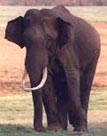
He is the founder member of the club. Though the aims and objectives encompass broader arenas, Manjunath has presently focussed his energies on conservation of the wild Asiatic elephant, especially those in Bangalore’s Banerghatta National Park. 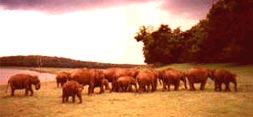 Today, he is taking us to see these elephants in their wild habitat. If we are lucky enough. We are introduced to Sriram, the founder trustee of the Asian Elephant Research and Conservation Centre, an NGO organisation involved in groundbreaking work on Elephants. Its co-founder, Dr. Raman Sukumar, fondly called ‘Elephant Man’, is today the undisputed authority on Asiatic elephants in the world. Unfortunately, Dr. Sukumar was away on tour. Also part of our team is Craig Raynes, a young Australian with a deep love for elephants and the forests, and has spent many moons with African elephants in Zimbabwe. But today, like us, he hopes to see the wild Asian elephant in its natural habitat. Sriram has brought along his charming wife and his son .
As we ease into our seats in the rugged and spacious Tata Sumo, Sriram slides the Sumo into gear and we are off.
 The Banerghatta National Park spread over 25,000 acres or approximately 104 square kilometers is the only National Park in the world other than Kenya at such close vicinity to the capital city of a state. It lies just 20 kms off the heart of India’s garden city, Bangalore. While in the city concerned individuals and organizations are fighting tooth and tail for the city’s stray dogs, in the deciduous forests of Banerghatta, elephants are running for cover.
The city slips away beneath the sumos’ tyres and in minutes the staid glass and mortar facades of buildings give way to foliage, and as the seemingly fresher air swishes in and out of the open windows, Manjunath gives us the rundown on the elephants. "Right now there are about 40 elephants resident in Banerghatta while over 200 are in their last stages of migration. It is only after the last of the migrants leave that we can take an accurate count of the resident elephants’, he says. The last census was taken in 1967 wasn’t it Sriram?", he asks and Sriram nods in agreement as he takes the final curve under a green arch, emblazoned in kannada with the letters "Banerghatta National Park" and brings the Sumo to rest before the high grilled green gates of the park.
As we step past the gates into the park, we are momentarily stuck by the presence of elephants in the enclosure. These are the domesticated ones. There are five of them. Two males, two females and a calf. The holidays crowds are milling around begging the mahouts to let them touch the trunks of the animals...
The mahout grunts. The elephant obliges and the children run off squealing with delight. We also follow suit.
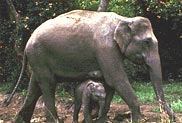
"She’s the Grandmother", says Manjunath, "and the little fella, who’s two years old is more attached to her than his own mother".
Now, where have I heard that before. We are then introduced to Nagesh. The wiry, cool ranger of the park. The new breed of foresters who seem to know and love their job. He’s just back after the early morning round-up drive of migrant elephants."There were more than 50 of them", he tells us " but they are in scattered formation in 3 separate herds".
As Nagesh and Manjunath work out the last minute modalities Sriram enlightens us on the Asian Elephant Research & Conservation Centre and its work. Of the 26 elephant corridors we are associated with, The corridor that lies within this area has narrowed due to habitation. Since the Govt has a fund constraint, we propose to bankroll the money to buy back the land from them and hand it back to the forest dept, to widen the corridor for movement. It is here that Manjunath is of immense importance to the project, due to his contact with the locals and the villagers. We nod in agreement as he and Nagesh, accompanied by a guard walk over to the Sumo. It’s a tighter squeeze in the Sumo this time. Mrs. Sriram joins her son at the back as Nagesh and Manjunath occupy the front seats.
 We are off. As the Sumo hugs the bumpy road, in dips and bumps, Sriram slows down occasionally to allow partridges to cross and take off in flight with the fanned white tips of their tail feathers spread out like Red Indian headgear.
The foliage is thicker and tighter now, though it is low bush and thorn, with few tall trees. The right side falls off into small valleys and climbs up again. "Elephants love this terrain. Its mixed foliage. They love the variety. Perfect bird country too, says Sriram.
Yes, answers Manjunath. "This is still teenage foliage. Grown out of the indiscriminate felling by the British of the Bangalore Cantonment during the Second world war for Charcoal and for Railway sleepers. Give it another 25 years and it will be in full bloom".
Banerghatta National Park is part of the Nilgiris and Eastern Ghats Elephant reserve, the largest in the country and home to over 2500 of India’s total population of around 22,000 Asian elephants. One of the migratory corridors for elephant movement passes through he Park. Illegal granite quarrying, livestock grazing, illegal squatters have forced the elephants to attack crops and therefore confront man.
Then all of a sudden, the green foliage turns an ashen, gloomy, Grey. A fine dust is all over, covering everything.
Granite dust, says Manjunath sourly and points out to the naked face of rock, whitish grey, fresh from the blast. As we look, the hillside blows out smoke, like tens of smokers lighting up, and then the rumble of the dynamite, as the sound echoes across the low valleys. "Quarrying is illegal. But who is to stop it? Even the local Panchayat member is a partner in the company. For the elephants this blasting sounds are confusing. It gives them the wrong signals."
We turn right after about 15 minutes of driving on the Banergahatta-Ragihalli road.
The freshly tarred road, courtesy the granite quarry owners, swoops down, meandering into the valley, before climbing up and coming to an end in a cluster of mudbaked houses. A Couple of the village elders come forward and greet Nagesh and Manjunath. They complain about crop damage and the shortage of fireworks. Manjunath listens with concern.
From here on it is by foot. We have to reach higher ground in order to catch the trail of the elephants. We move out in single file.
 The narrow foot trails loop up and down like a ribbon, and after an hour of walking, we finally reach the crest of the hill on the southern boundary of the Park. Stopping only to check elephant dung. Mounds of greenish black speckled with orange coloured fruit seeds. The elephants contribution to seed dispersal and plant regeneration. Most of the hill tops and scattered areas on their sides are shorn of foliage. We are standing on almost bare rock. Manjunath and Nagesh scan the opposite hill. The villagers point to the crest. And sure enough there is the puff of smoke followed by sharper crack. This time it is the fireworks. The drive is on as the forest workers are chasing them down the crest of the hill. Now all we have to do is wait in silence. Each of us squat down on the rock and eagerly focus on the opposite hill.
It is 4.30 in the evening now. It should take them at least an hour to get to where we are. Even from our vantage point it is difficult to spot the elephants among the dense cover.
The smoke rings of the firecrackers and the crashing sounds are clearly audible mixed with the whooping sounds of the forest guards adding to the din. The smoke rings get closer and suddenly Manjunath points to a clearing where we manage to catch a flash of black as the foliage parts for the herd.
A single elephant needs more than 10sqkms of land for sustenance. They are known to travel upto 600 kms in a single migration. A herd of 9 elephants from Banerghatta suddenly landed up at Tirupati, where they are till today. They slide downhill on their rumps in single file. A great sight. Only females with calf and solitary male tuskers are known to be violent when provoked. We’ll have to move further over to the side of the hill to get a closer view, says Manjunath. We move quickly along the shoulder of the hill and go down further to a clearing. From here we can see a break in the corridor of foliage. "Sssssssssssh!...say the villagers here they come. Craig gets in position with his handycam and I squat behind him. And suddenly they burst into focus. With the sound of cracking foliage, the herd is moving right in front of our eyes. More than twenty in all. At a jogging pace, the larger ones in front and the calves in between. All in single file. Like soldiers at a dress rehearsal.
And then it hit me. They were running like refugees. Not knowing what lies for them across the border. But, sadly unlike refugees, they’ll be chased right back. By firecrackers and forest guards of neighbouring Tamil Nadu. Little time to sleep and even less food to eat.
The sheer thrill of seeing them in the wild on our very first watch is immediately washed away by a feeling of helplessness for the elephants. The ride back into town is in silence broken only by packs of rose ringed parakeets squawking away in the twilight. It is the evening of Karthika Paurnami and the full moon rises over the hills of Banergahatta and reflecting off the corridors of jungle where a herd of elephants are on the run.
I lean out of the window to look up at the moon before it disappears behind Bungler’s real estate skyline,
The once familiar shape of the man on the moon looks a little different tonight.
It looks more like an elephant.