
Avoiding and Treating Blisters
Cause and Effect
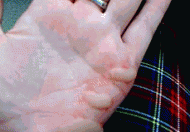
Blisters form when the skin rubs against another surface, causing friction. First, a tear occurs within the upper layers of the skin, forming a space between the layers while leaving the surface intact. Then fluid seeps into the space.
Soles and palms are most commonly affected for several reasons. The hands and feet often rub against shoes, skates, rackets, or other equipment. Blister formation usually requires thick and rather immobile epidermis, as is found in these areas. In addition, blisters form more easily on moist skin than on dry or soaked skin, and warm conditions assist blister formation.
Blister Care
If you get a blister, you’ll want to relieve your pain, keep the blister from enlarging,
and stave off infection. Specific steps depend on the size of the blister and whether or not it is intact. You can treat the vast majority of blisters yourself and need to call a doctor only if blisters become infected, recur frequently, form in unusual locations, or are very severe. Signs of infection include pus draining from the blister, very red or warm skin around the blister, and red streaks leading away from the blister.
Small, intact blisters that don’t cause discomfort usually need no treatment. Nature’s best protection against infection is a blister’s own skin, or roof. To protect the roof, this type of blister can be covered with a small adhesive bandage if practical.
Larger or painful blisters that are intact should be drained without removing the roof. First clean the blister with rubbing alcohol or antibiotic soap and water. Then heat a straight pin or safety pin over a flame until the pin glows red, and allow it to cool before puncturing a small hole at the edge of the blister.
Drain the fluid with gentle pressure, then apply an antibiotic ointment such as bacitracin with polymyxin B (double antibiotic ointment) or bacitracin alone. Avoid ointments that contain neomycin because they are more likely to cause an allergic reaction.
Finally, cover the blister with a bandage. Change the dressing daily--more frequently if it becomes wet, soiled, or loose.
Blisters with small tears are treated the same as those that you have punctured. Blisters with larger tears should be "unroofed" carefully with fine scissors, and the base should be cleansed thoroughly with soap and water or an antibacterial cleanser. Apply antibiotic ointment and bandages as described above.
Additional padding may be necessary for exercise or sports. Ring-shaped pads made of felt will protect small blisters. Larger blisters may require dressings. Some of the many available dressing materials are DuoDerm (ConvaTec, Princeton, New Jersey), Spenco 2nd Skin (Spenco Medical Corporation, Waco, Texas), Vigilon (CR Bard Inc, Murray Hill, New Jersey), and Opsite (Smith & Nephew United, Largo, Florida). Additional, doughnutshaped padding made of felt or lamb’s wool may be applied over the area surrounding the blister. Then the entire dressing can be applied to help keep the dressing in place on sweaty skin.